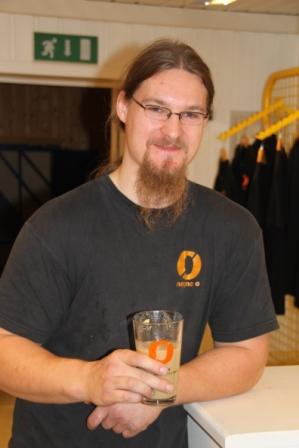
We are pleased to get Haldor Berge as part of our Nøgne Ø team, which now counts a total of 13 dedicated individuals. More info on Haldor will follow soon.
I guess we all have our different ceremonies. One of mine is to smoke good cigars in my garden during summer. For a while now I have refused to accept that summer is over, but now I cannot deny it, and some days ago I had my last cigar. For this season, that is. Ahead is winter, chill, snow, darkness and hardship.
So which cigar did I choose to end the season?
A Hawk 1968 XXL Torpedo. And what a treat! At ring gauge 68, this is among the smoothest cigars I have ever had. Rich with vanilla, cloves and cocoa. And a perfect draw, which is typical for any cigar made by Chess Cigar Factory
This cigar is indeed a gentle monster. Monstrous to the eye, but gentle in any other way.
I am proud to claim that this is a Norwegian cigar!!!
Check out: http://www.sigar.com/contents/no/d89.html
Recently we have received some comments about that our Wit has changed. Those who claim so are actually right. It was not purposely done by us, but happened as we started to use locally grown wheat in this beer.
We would like to claim that the change in flavor has made our Wit more thirst quenching and lighter in body; maybe closer to the historically authentic Wit(?)!
Like it or dislike it? We are proud to use local grains as it has less of an impact on the environment!
For the past couple of years, we have had the routine of brewing and bottling two brews a week. Recently we have done three, and this week we brewed 4 beers and bottled the same amount. This is quite an achievement, and everybody (and in particular our bottling crew) are pretty knackered.
In the middle of all these crazy days, I just had to take a photo of our Imperial Stout getting out of hand.
When we start the fermentation of a beer, we add yeast. The brewer uses a microscope and assesses the yeast he will use, then he calculates how much yeast he needs to add to this specific batch.
In general, our rule is this: Target is to introduce enough yeast cells to give 1 million yeast cells per degree Plato per milliliter. In this case, the imperial Stout is brewed at 22P, so we are talking 22 million yeast cells per milliliter. As there is 45 hectoliters in our fermenting vessels, a substantial number of yeast cells needs to be added(or pitched as we say). But if for some reason the maths did not work out, or maybe the quality of the yeast was not homogeneous or the observation through the microscope was inaccurate, then the beer can get the wrong amount of yeast pitched. If the beer gets too much yeast, it will ferment too quick and very aggressively with lots of foam. This photo shows what it looks like in the morning, when a beer has fermented out of control during the night.
Summer is over. It has been really hectic for those of us who were not on vacation, but now we are in full swing, brewing and bottling.
As darker and colder times are approaching, we are brewing more dark, rich and strong!